<?xml version="1.0" encoding="utf-8"?><feed xmlns="http://www.w3.org/2005/Atom" ><generator uri="https://jekyllrb.com/" version="3.10.0">Jekyll</generator><link href="https://bengutteridge.github.io/feed.xml" rel="self" type="application/atom+xml" /><link href="https://bengutteridge.github.io/" rel="alternate" type="text/html" /><updated>2026-11-16T10:19:50-08:00</updated><id>https://bengutteridge.github.io/feed.xml</id><title type="html">Ben Gutteridge</title><subtitle>Machine Learning PhD candidate in the AIMS CDT at the University of Oxford</subtitle><author><name>Ben Gutteridge</name><email>beng@robots.ox.ac.uk</email></author><entry><title type="html">Best Books of 2025</title><link href="https://bengutteridge.github.io/posts/2025/12/28/" rel="alternate" type="text/html" title="Best Books of 2025" /><published>2025-12-28T00:00:00-08:00</published><updated>2025-12-28T00:00:00-08:00</updated><id>https://bengutteridge.github.io/posts/2025/12/best-books-2025</id><content type="html" xml:base="https://bengutteridge.github.io/posts/2025/12/28/"><![CDATA[<p><img src="/images/books-2025-pie.png" alt="2025 books pie chart" />
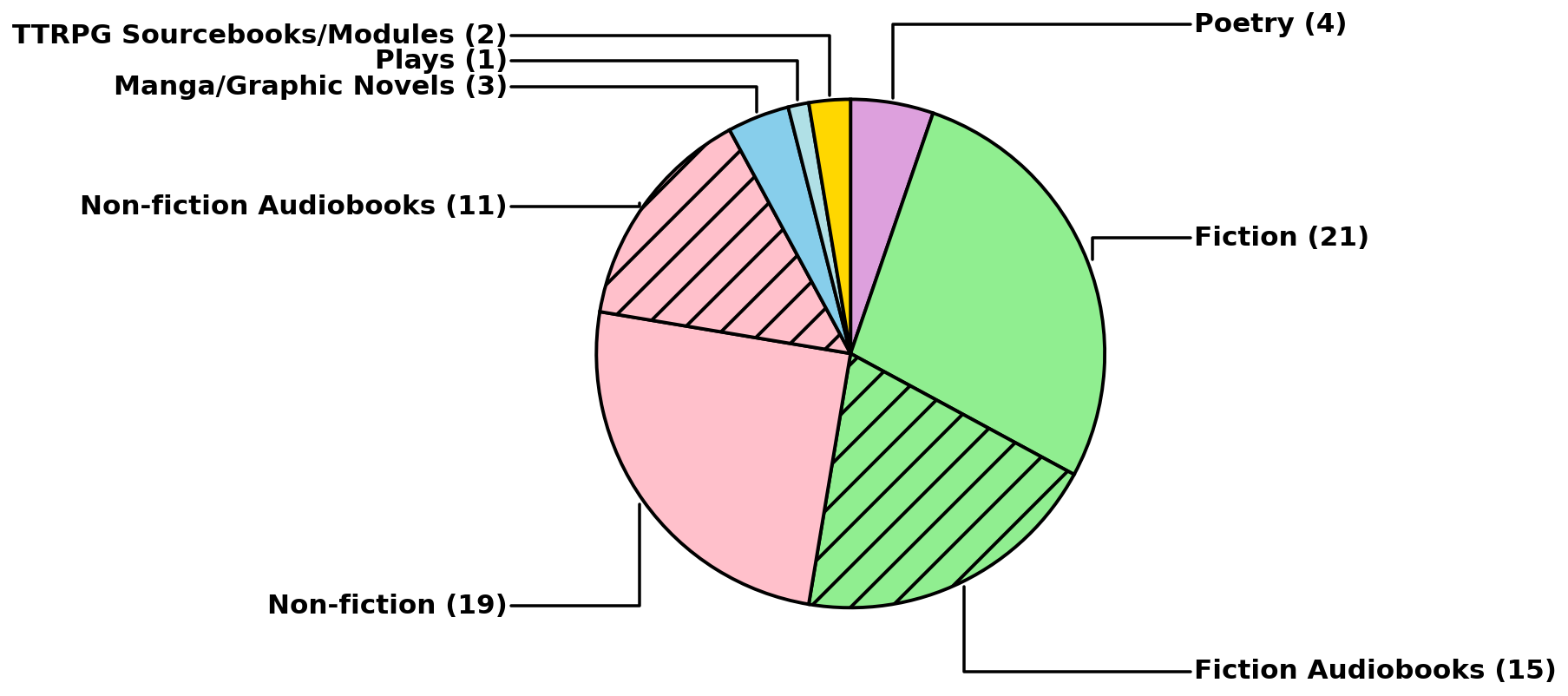
Continuing the tradition from <a href="/_posts/2024-12-31-best-books-2024">last year</a>, here is the round-up of the 76 books I read in 2025 (one more than last year, just), what kinds of books they were, how I read them, and brief reviews of some of my favourites. The goal for next year: read my height (and read more women. &lt;20% is quite poor).</p>

<p>As ever, please <a href="https://www.goodreads.com/friend/i?feature=friend-invite-url&amp;invite_token=ODc5ZjdhYzgtOGZkNy00MDQ2LTgzZmEtODlmYTcyZDEzMzRj">befriend me on Goodreads</a> 🙏</p>

<p>In no particular order:</p>

<h2 id="fiction">Fiction</h2>

<p><strong><em>Perfection</em> (2022) by Vincenzo Latronico</strong></p>

<p>An incisive little book that subjects cynical, insecure, commodified, self-involved, desperate, slightly pathetic Millennial (and elder Gen Z) yuppie life to uncomfortable scrutiny. Hit a little too close to home. Good stuff.</p>

<p><strong><em>Rebecca</em> (1938) by Daphne du Maurier</strong></p>

<p>All the suspense of gothic horror without a hint of the supernatural. The narrator is extremely relatable as an insecure young woman that slowly finds her voice, but never truly steps out of Rebecca’s looming, ever-morphing shadow.</p>

<p><strong><em>The Tartar Steppe</em> (1940) by Dino Buzzati</strong></p>

<p>An incredible book, somehow both mysterious and completely unsubtle. A feature-length spiritual predecessor to Pink Floyd’s <em>Time</em> that will freak you the fuck out and make you resolve to finally do That One Thing that will change your life for the better. Maybe next month.</p>

<blockquote>
  <p>“That very night time began to slip by him beyond recall… The sun shines high in the sky and it seems to have no wish to set. But at a certain point we turn round, almost instinctively, and see that a gate has been bolted behind us, barring our way back.”</p>
</blockquote>

<p>Chilling stuff.</p>

<p><strong><em>American Pastoral</em> (1997) by Philip Roth</strong></p>

<p>While reading this I found myself frustrated more than a few times: at Roth’s ferociously overwritten prose style, rambling tangents, seemingly reactionary politics, and misogyny. He is clearly trying <em>so hard</em> to write a Great American Novel — but he may well have succeeded. Roth’s hero, the Swede, hidden behind two layers of unreliable narrator, feels so real, is so empathetically drawn, so complete; a beneficiary and victim of The American Dream that deserves to stand alongside the Willy Lomaxes and Jim Caseys.</p>

<p>For me, the frustrations and perfections of <em>American Pastoral</em> are brilliantly summed up by Richard Ford, writing after Roth’s death:</p>

<blockquote>
  <p>“<em>The fusing powers of Roth’s imagination, conviction and raging intelligence are everywhere evident and exhilarating. There is about it a profound and heartening sense (and it is a profound book) that the verbal construction you’re undertaking as a reader represents absolutely the only way this mighty story could ever be brought into existence.</em> American Pastoral <em>stares back at me audaciously unblinking as a great novel. And although such a rambunctious piece of artifice can inevitably not be perfect, it is nonetheless in all its ways right.</em>”</p>
</blockquote>

<p><strong><em>War and Peace</em> (1869) by Leo Tolstoy</strong></p>

<p>I’m sure I will think about this for the rest of my life. It’s a slog at times, particularly some of the <em>War</em> segments, and the unbearably didactic Epilogue Part II (way to stick the landing Leo), but there is just so much in this book to love and in which to find yourself. To read <em>War &amp; Peace</em> is to feel Tolstoy reaching across the centuries and grasping your hand and saying “I see you, we are both human. I have looked around and thought hard, and this is everything I see and understand about humanity put to paper.”</p>

<p>It’s been said of Ulysses that “all of life is contained within its pages”. I haven’t read it, but I’d be willing to bet that <em>War &amp; Peace</em> fits the description better.</p>

<h2 id="non-fiction">Non-fiction</h2>

<p><strong><em>Pour Me</em> (2015) by A.A Gill</strong></p>

<p>Gill’s concise, romantic memoir of alcoholism and becoming a writer after failing as an artist is an arrogant, acerbic barrage of non-stop solid gold absolute fucking bangers. A strong contender for the best memoir I have ever read.</p>

<p><strong><em>How Migration Really Works</em> (2023) by Hein de Haas</strong></p>

<p>This should be required reading. 22 myths (both left- and right-wing darlings!) about migration debunked. It’s infuriating that Starmer and every other world leader either already knows the contents of this book, and is ignoring it to serve political aims, or is wilfully ignorant of the facts.</p>

<p>I’d say the main takeaways are these:</p>
<ul>
  <li>The impacts of migration, positive or negative, are almost always very small</li>
  <li>Big business is pro-migration as it makes the rich (slightly) richer. The poor stay the same (or, at worst, get a tiny bit poorer). Meanwhile, governments pass legislation that benefits big business at the expense of workers, while turning workers against one another by blaming migrants for these problems.</li>
  <li>Anti-migration legislation <em>increases</em> net migration: it does little to stop people coming in, and actively encourages them to get in ‘before it’s too late’, while preventing them from leaving again.</li>
</ul>

<p><strong><em>Blackshirts and Reds</em> (1997) by Michael Parenti</strong></p>

<p>A slim (~170-odd page), iconoclastic grenade of a book that will challenge your Western liberal consensus ideas of 20th-century communist movements. B&amp;R can feel so bombastic and bitter at times that you will find yourself recoiling at some of the claims. Much like for ‘actually existing’ socialism itself, don’t let the fact that this book isn’t perfect let you dismiss it in favour of a deeply flawed capitalist system/story that feels inevitable (i.e. Fisher’s <a href="https://en.wikipedia.org/wiki/Capitalist_Realism">capitalist realism</a>).</p>

<p><strong><em>Technofeudalism: What Killed Capitalism</em> (2023) by Yanis Varoufakis</strong></p>

<p>Ambitious to the point of perhaps over-reaching slightly, but excellent. Explains clearly, and makes a compelling case against, big tech’s ability to exploit free labour from its users. Makes a compelling case that our economic system has shifted away from products in competition to monopolies parasitically extracting rent from both physical assets and a carved-up digital commons. Clearly and fascinatingly explains the emergence of big tech monopolies directly from post-2008 low interest rates. (Varoufakis’ frequent refrain, “socialism for bankers, austerity for everyone else” is funny, tendentious, and basically fair.) His vision of a universal basic dividend and anarcho-syndicalist markets-without-capitalism paints a pretty picture of a utopia of democratised companies and small-scale publically-owned algorithms. The best of Varoufakis I have read; go for this over <em>Another Now</em>.</p>

<p><strong><em>Doppelganger: A Trip into the Mirror World</em> (2024) by Naomi Klein</strong></p>

<p>An impressive piece of memoir meets cultural-political-economic analysis. Klein covers a lot of ground — conspiracy theories, diagonalism, inequality, autism, climate change, COVID, Israel — and largely succeeds in making it all hang together coherently, and around a compelling analogy, no less — that of the doppelganger. We get an exploration of personal branding (the commodification of the self) as one alienating form of doppelganging, the language and fronts of the left being aped by right-wing conspiracists as another, the healthy self and its exhortation by borderline eugenicist ‘wellness’ hucksters as another, settler colonial nations as doppelgangers of their progenitors, the “changeling” mythology of autistic children… and that’s just a few I noted down while reading. Similar (in its attempt to holisitically tackle culture and identity alongside political and economic structures) to Ash Sarkar’s excellent <em>Minority Rule</em>, but more comprehensive, and probably better overall. A potent leftist gateway drug.</p>

<p><strong>Honourable mentions:</strong> two excellent general (i.e. mainly political) histories I read this year, of the United States and postwar Britain respectively, were <strong><em>These Truths</em> (2018)</strong> by Jill Lepore, and <strong><em>A History of Modern Britain</em> (2007)</strong> by Andrew Marr.</p>

<h2 id="full-list">Full list</h2>
<p>(11 books, marked with <em>italics</em>, were re-reads)</p>

<p><strong>Fiction</strong> (21)</p>
<ul>
  <li>My Friends (Matar)</li>
  <li>New York (Rutherfurd)</li>
  <li>The Trial (Kafka)</li>
  <li>Eurotrash (Kracht)</li>
  <li>Return of the King (Tolkien)</li>
  <li>The Tartar Steppe (Buzzatti)</li>
  <li>War &amp; Peace (Tolstoy)</li>
  <li>Another Now (Varoufakis)</li>
  <li>Perfection (Latronico)</li>
  <li>The Hound of the Baskervilles (Doyle)</li>
  <li>The Left Hand of Darkness (Le Guin)</li>
  <li>Rebecca (Du Maurier)</li>
  <li>American Pastoral (Roth)</li>
  <li>The Hallmarked Man (Rowling)</li>
  <li><em>La Belle Sauvage (Pullman)</em></li>
  <li>The Passion According to G.H. (Lispector)</li>
  <li><em>The Secret Commonwealth (Pullman)</em></li>
  <li>The Rose Field (Pullman)</li>
  <li>The Curious Case of Benjamin Button (Fitzgerald)</li>
  <li>Tropic of Cancer (Miller)</li>
  <li>A Christmas Carol and Other Christmas Writings (Dickens)</li>
</ul>

<p><strong>Non-fiction</strong> (19)</p>
<ul>
  <li>This Land (Jones)</li>
  <li>The Autobiography of Benjamin Franklin</li>
  <li>The Colossus of New York (Whitehead)</li>
  <li>These Truths (Lepore)</li>
  <li>Technofeudalism (Varoufakis)</li>
  <li>Saving Capitalism (Reich)</li>
  <li>The Use of Knowledge in Society (Hayek)</li>
  <li>A History of Modern Britain (Marr)</li>
  <li>The Fran Lebowitz Reader</li>
  <li>Economics: a User’s Guide (Chang)</li>
  <li>Hostage to History (Hitchens)</li>
  <li>Socialism Utopian and Scientific (Engels)</li>
  <li>Blackshirts &amp; Reds (Parenti)</li>
  <li>How Migration Really Works (de Haas)</li>
  <li>A New World Begins (Popkin)</li>
  <li>Washington Bullets (Prashad)</li>
  <li>Supremacy (Olson)</li>
  <li>Talking to My Daughter About the Economy (Varoufakis)</li>
  <li>Homage to Catalonia (Orwell)</li>
</ul>

<p><strong>Fiction Audiobooks</strong> (15)</p>
<ul>
  <li>Babel (Kuang)</li>
  <li>Odyssey (Fry)</li>
  <li>The Memoirs of Sherlock Holmes (Doyle)</li>
  <li><em>Northern Lights (Pullman)</em></li>
  <li><em>The Subtle Knife (Pullman)</em></li>
  <li>The Complete Yes Minister (Lynn, Jay)</li>
  <li><em>The Amber Spyglass (Pullman)</em></li>
  <li><em>The Casual Vacancy (Rowling)</em></li>
  <li><em>The Running Grave (Rowling)</em></li>
  <li><em>The Martian (Weir)</em></li>
  <li><em>Project Hail Mary (Weir)</em></li>
  <li>Heavy Weather (Wodehouse)</li>
  <li>Blandings Castle and Elsewhere (Wodehouse)</li>
  <li>Lord Emsworth and Others (Wodehouse)</li>
  <li><em>HP &amp; the Philosopher’s Stone (Rowling)</em></li>
</ul>

<p><strong>Non-fiction Audiobooks</strong> (11)</p>
<ul>
  <li>Strong Female Character (Brady)</li>
  <li>The Trading Game (Stevenson)</li>
  <li>Everything is Tuberculosis (Green)</li>
  <li>Unruly (Mitchell)</li>
  <li>Get In (Maguire)</li>
  <li><em>Politics on the Edge (Stewart)</em></li>
  <li>Minority Rule (Sarkar)</li>
  <li>Atomic Habits (Clear)</li>
  <li>Pour Me (Gill)</li>
  <li>Hamilton (Chernow)</li>
  <li>Doppelganger (Klein)</li>
</ul>

<p><strong>Plays</strong> (1)</p>
<ul>
  <li>The Invention of Love (Stoppard)</li>
</ul>

<p><strong>Poetry</strong> (4)</p>
<ul>
  <li>Selected Poems (Whitman)</li>
  <li>Paradise Lost (Milton)</li>
  <li>Delicious Laughter (Rumi, Barks)</li>
  <li>The Waste Land and Other Poems (Eliot)</li>
</ul>

<p><strong>Graphic Novels</strong> (3)</p>
<ul>
  <li>The Complete Maus (Spiegelman)</li>
  <li>Paradise Lost (Auladell, Milton)</li>
  <li>Watchmen (Moore)</li>
</ul>

<p><strong>RPG Sourcebooks</strong> (2)</p>
<ul>
  <li>Alice is Missing</li>
  <li>Delta Green: Need to Know</li>
</ul>]]></content><author><name>Ben Gutteridge</name><email>beng@robots.ox.ac.uk</email></author><category term="daily blog" /><category term="books" /><summary type="html"><![CDATA[Continuing the tradition from last year, here is the round-up of the 76 books I read in 2025 (one more than last year, just), what kinds of books they were, how I read them, and brief reviews of some of my favourites. The goal for next year: read my height (and read more women. &lt;20% is quite poor).]]></summary></entry><entry><title type="html"></title><link href="https://bengutteridge.github.io/posts/2025/02/17/" rel="alternate" type="text/html" title="" /><published>2025-02-17T00:00:00-08:00</published><updated>2025-02-17T00:00:00-08:00</updated><id>https://bengutteridge.github.io/posts/2025/02/</id><content type="html" xml:base="https://bengutteridge.github.io/posts/2025/02/17/"><![CDATA[<h3 id="yesterday">Yesterday</h3>
<ul>
  <li>NOTHING!</li>
</ul>

<h3 id="todo">TODO</h3>
<ul>
  <li>FILL IN BLOG POST!</li>
  <li>BEN DIDN’T FILL IN HIS BLOG POST TODAY BECAUSE HE’S LAZY AND HE SUCKS!</li>
</ul>]]></content><author><name>Ben Gutteridge</name><email>beng@robots.ox.ac.uk</email></author><category term="daily blog" /><summary type="html"><![CDATA[Yesterday NOTHING!]]></summary></entry><entry><title type="html"></title><link href="https://bengutteridge.github.io/posts/2025/02/12/" rel="alternate" type="text/html" title="" /><published>2025-02-12T00:00:00-08:00</published><updated>2025-02-12T00:00:00-08:00</updated><id>https://bengutteridge.github.io/posts/2025/02/</id><content type="html" xml:base="https://bengutteridge.github.io/posts/2025/02/12/"><![CDATA[<h3 id="last-few-days">Last few days</h3>
<ul>
  <li>Cleaning up LR project repo</li>
  <li>Getting started on confirmation stuff</li>
</ul>]]></content><author><name>Ben Gutteridge</name><email>beng@robots.ox.ac.uk</email></author><category term="daily blog" /><summary type="html"><![CDATA[Last few days Cleaning up LR project repo Getting started on confirmation stuff]]></summary></entry><entry><title type="html"></title><link href="https://bengutteridge.github.io/posts/2025/01/31/" rel="alternate" type="text/html" title="" /><published>2025-01-31T00:00:00-08:00</published><updated>2025-01-31T00:00:00-08:00</updated><id>https://bengutteridge.github.io/posts/2025/01/</id><content type="html" xml:base="https://bengutteridge.github.io/posts/2025/01/31/"><![CDATA[<h3 id="update">Update</h3>
<ul>
  <li>Spent the last two weeks grinding out a paper submission for ICML 2025. Watch this space…</li>
</ul>]]></content><author><name>Ben Gutteridge</name><email>beng@robots.ox.ac.uk</email></author><category term="daily blog" /><summary type="html"><![CDATA[Update Spent the last two weeks grinding out a paper submission for ICML 2025. Watch this space…]]></summary></entry><entry><title type="html"></title><link href="https://bengutteridge.github.io/posts/2025/01/14/" rel="alternate" type="text/html" title="" /><published>2025-01-14T00:00:00-08:00</published><updated>2025-01-14T00:00:00-08:00</updated><id>https://bengutteridge.github.io/posts/2025/01/</id><content type="html" xml:base="https://bengutteridge.github.io/posts/2025/01/14/"><![CDATA[<h3 id="yesterday">Yesterday</h3>
<ul>
  <li>VOC partially implemented LR</li>
  <li>Tonshoff VOC fix for Lyapunov</li>
</ul>

<h3 id="todo">TODO</h3>
<ul>
  <li>Finish VOC for LR, and synth-voc</li>
  <li>Try running exp results overnight</li>
  <li>If time, get Tonshoff into our repo and insert the range measure stuff into it</li>
</ul>]]></content><author><name>Ben Gutteridge</name><email>beng@robots.ox.ac.uk</email></author><category term="daily blog" /><summary type="html"><![CDATA[Yesterday VOC partially implemented LR Tonshoff VOC fix for Lyapunov]]></summary></entry><entry><title type="html"></title><link href="https://bengutteridge.github.io/posts/2025/01/13/" rel="alternate" type="text/html" title="" /><published>2025-01-13T00:00:00-08:00</published><updated>2025-01-13T00:00:00-08:00</updated><id>https://bengutteridge.github.io/posts/2025/01/</id><content type="html" xml:base="https://bengutteridge.github.io/posts/2025/01/13/"><![CDATA[<h3 id="last-week">Last week</h3>
<ul>
  <li>Finished off VOC and PCQM PRs for Lyapunov project</li>
  <li>Got back into LR project: re-read working doc, reviewed a load of PRs</li>
  <li>LR meeting + X, concrete next steps decided</li>
</ul>

<h3 id="todo">TODO</h3>
<ul>
  <li>Implement voc and synth-voc into LR repo</li>
  <li>Pick and implement at least one demonstrative architecture</li>
</ul>]]></content><author><name>Ben Gutteridge</name><email>beng@robots.ox.ac.uk</email></author><category term="daily blog" /><summary type="html"><![CDATA[Last week Finished off VOC and PCQM PRs for Lyapunov project Got back into LR project: re-read working doc, reviewed a load of PRs LR meeting + X, concrete next steps decided]]></summary></entry><entry><title type="html"></title><link href="https://bengutteridge.github.io/posts/2025/01/07/" rel="alternate" type="text/html" title="" /><published>2025-01-07T00:00:00-08:00</published><updated>2025-01-07T00:00:00-08:00</updated><id>https://bengutteridge.github.io/posts/2025/01/</id><content type="html" xml:base="https://bengutteridge.github.io/posts/2025/01/07/"><![CDATA[<h3 id="yesterday">Yesterday</h3>
<ul>
  <li>Sorted VOC</li>
</ul>

<h3 id="todo">TODO</h3>
<ul>
  <li>Fix VOC and struct bugs, add PCQM</li>
  <li>LR PR reviews</li>
</ul>]]></content><author><name>Ben Gutteridge</name><email>beng@robots.ox.ac.uk</email></author><category term="daily blog" /><summary type="html"><![CDATA[Yesterday Sorted VOC]]></summary></entry><entry><title type="html"></title><link href="https://bengutteridge.github.io/posts/2025/01/06/" rel="alternate" type="text/html" title="" /><published>2025-01-06T00:00:00-08:00</published><updated>2025-01-06T00:00:00-08:00</updated><id>https://bengutteridge.github.io/posts/2025/01/</id><content type="html" xml:base="https://bengutteridge.github.io/posts/2025/01/06/"><![CDATA[<h3 id="todo">TODO</h3>
<ul>
  <li>Other LRGB datasets PR for A</li>
</ul>]]></content><author><name>Ben Gutteridge</name><email>beng@robots.ox.ac.uk</email></author><category term="daily blog" /><summary type="html"><![CDATA[TODO Other LRGB datasets PR for A]]></summary></entry><entry><title type="html"></title><link href="https://bengutteridge.github.io/posts/2025/01/03/" rel="alternate" type="text/html" title="" /><published>2025-01-03T00:00:00-08:00</published><updated>2025-01-03T00:00:00-08:00</updated><id>https://bengutteridge.github.io/posts/2025/01/</id><content type="html" xml:base="https://bengutteridge.github.io/posts/2025/01/03/"><![CDATA[<h3 id="todo">TODO</h3>
<ul>
  <li>Fix up LapPE for A, clean up repo, raise PR
    <ul>
      <li>Look at exps from before and run a select few with LapPE</li>
    </ul>
  </li>
  <li>LR:
    <ul>
      <li>Look at pre-Xmas notes, where we left off</li>
      <li>Review PRs you haven’t looked at</li>
      <li>Send a message to J and S</li>
    </ul>
  </li>
</ul>]]></content><author><name>Ben Gutteridge</name><email>beng@robots.ox.ac.uk</email></author><category term="daily blog" /><summary type="html"><![CDATA[TODO Fix up LapPE for A, clean up repo, raise PR Look at exps from before and run a select few with LapPE LR: Look at pre-Xmas notes, where we left off Review PRs you haven’t looked at Send a message to J and S]]></summary></entry><entry><title type="html">Best Books of 2024</title><link href="https://bengutteridge.github.io/posts/2024/12/31/" rel="alternate" type="text/html" title="Best Books of 2024" /><published>2024-12-31T00:00:00-08:00</published><updated>2024-12-31T00:00:00-08:00</updated><id>https://bengutteridge.github.io/posts/2024/12/best-books-2024</id><content type="html" xml:base="https://bengutteridge.github.io/posts/2024/12/31/"><![CDATA[<p><img src="/images/books_2024_pie_chart.png" alt="2024 books pie chart" />
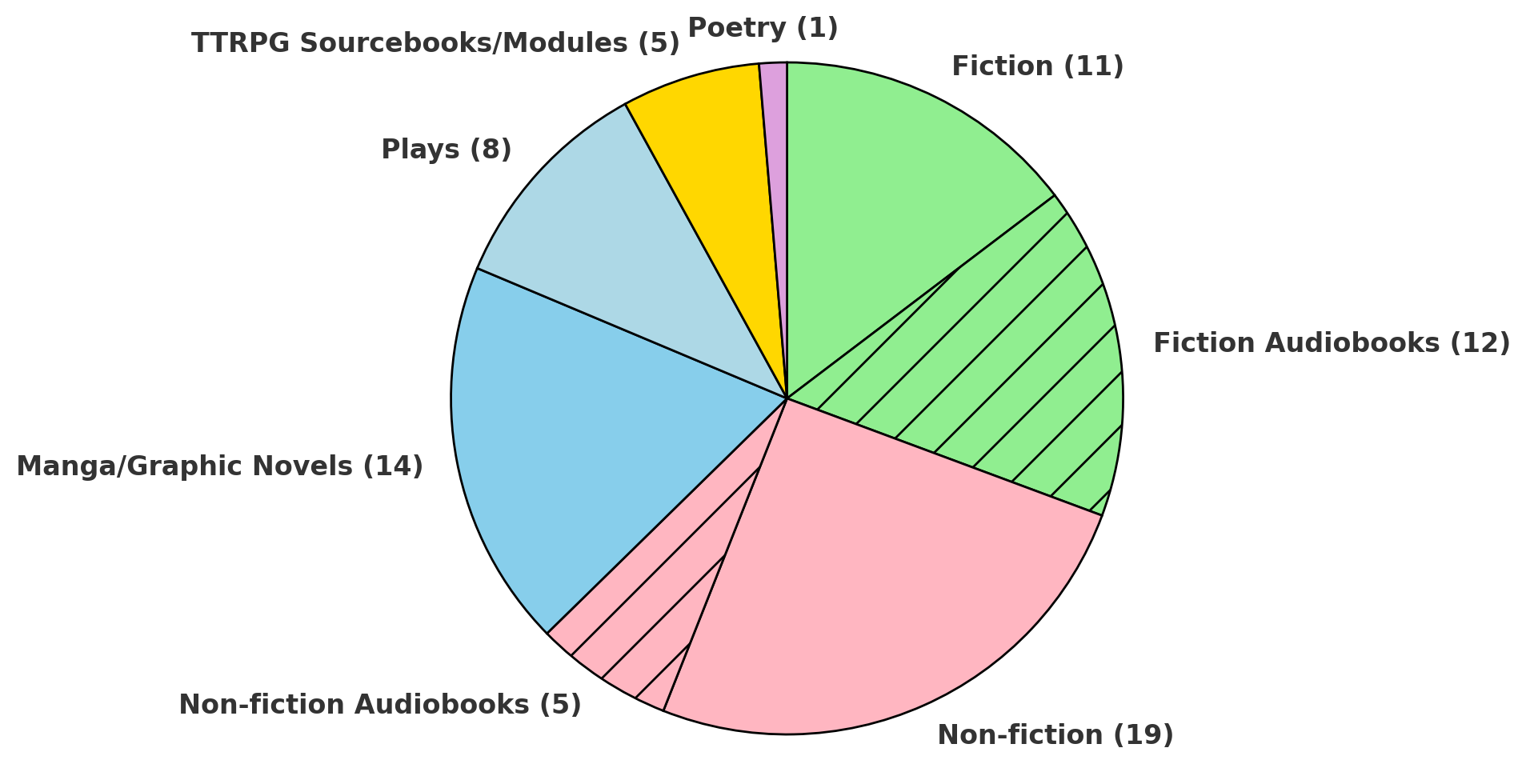
I read 75 books in 2024 (please <a href="https://www.goodreads.com/friend/i?feature=friend-invite-url&amp;invite_token=ODc5ZjdhYzgtOGZkNy00MDQ2LTgzZmEtODlmYTcyZDEzMzRj">befriend me on Goodreads</a> 🙏), by far my best-ever total, and I’m feeling smug, so I thought I’d do a quick review of my top 5 fiction and non-fiction books of the year.</p>

<p>In no particular order:</p>

<h2 id="fiction">Fiction</h2>
<p><strong><em>Great Expectations</em> (1861) by Charles Dickens</strong></p>

<p><em>“Her contempt for me was so strong, that it became infectious, and I caught it.”</em></p>

<p>My first proper Dickens. Funny and tragic, great characters, witty, richly thematic, idealistic but grounded.</p>

<p><strong><em>It</em> (1986) by Stephen King</strong></p>

<p>While King’s prose is sometimes excrutiatingly waffling, it does have a certain conversational, folksy charm which suits the audiobook format especially well. The story is truly epic in its scope and themes: childhood, memory, fear, friendship, etc etc. Laid out the blueprint for the now-classic supernatural coming-of-age tale.</p>

<p><strong><em>Watership Down</em> (1972) by Richard Adams</strong></p>

<p><em>“All the world will be your enemy… be cunning and full of tricks and your people shall never be destroyed.”</em></p>

<p>I expected <em>Wind in the Willows</em>; I got <em>Lord of the Rings</em> with rabbits. Adams crafts a convincing lapine language and mythology around El-ahrairah, the ‘Prince with a Thousand Enemies’ which nicely complements the epic saga of a band of outcast rabbits searching for, establishing, and defending a new home.</p>

<p><strong><em>Shadowdark RPG</em> (2023) by Kelsey Dionne</strong></p>

<p>Tenuously a fiction book, but I have to give credit to this masterclass in RPG writing: simple but clever rules that utilise common sense and leave ample room for flexibility; a succinct but thematic writing style that respects the GM/player’s time; heavily stylised, old-school art and formatting. You could run great TTRPGs sessions for decades using only this book as a resource and never run out of inspiration. The best of modern D&amp;D and the old-school renaissance together in one beautifully-made A5 book.</p>

<p><strong><em>Wuthering Heights</em> (1847) by Emily Bronte</strong></p>

<p><em>“I have no pity! I have no pity! The more the worms writhe, the more I yearn to crush out their entrails!”</em></p>

<p>One of the best books I’ve ever read. So evocative and cinematic. I keep thinking of the word <em>pagan</em>, from this review in the preface:</p>

<p><em>“Too odiously and abominably pagan to be palatable even to the most vitiated class of English readers”</em></p>

<p>I cannot imagine a more compelling endorsement for a book.</p>

<h2 id="non-fiction">Non-fiction</h2>

<p><strong><em>Essays</em> (1941)/<em>Down and Out in Paris and London</em> (1933) by George Orwell</strong></p>

<p><em>“His body might be in the spike, but his spirit soared far away, in the pure aether of the middle classes.”</em></p>

<p><em>“It is a strange fact, but it is unquestionably true that almost any English intellectual would feel more ashamed of standing to attention during ‘God save the King’ than of stealing from a poor box.”</em></p>

<p>A bit of a cheat, but <em>Down and Out</em> is basically two extended essays and (and parts of it became separate essays). An authoritative voice on almost any topic; I’m especially impressed by his ability to write intelligently (but, crucially, not <em>intellectually</em>) about socialism, and why it needn’t necessarily be at odds with patriotism. D&amp;O is wonderfully grimy and basically a proto-<em>Kitchen Confidential</em>.</p>

<p><strong><em>Budapest</em> by Victor Sebestyen (2022)</strong></p>

<p>Read before/while visiting earlier this year. Casts the story of the city as the development of the Hungarian national character: a relatable antihero, perennial underdog and occasional badly-behaved overdog. Tight, almost to the point of being insufficiently detailed. Loads of nice little asides about the city itself which made the trip that much richer. The last few chapters, from the Red Army siege through occupation, revolution and up to the fall of the USSR was enthralling enough to make me forget that I forgot I was absolutely knackered and stuffed into a delayed Ryanair flight at midnight.</p>

<p><strong><em>A Promised Land</em> (2020) by Barack Obama</strong></p>

<p>Barack Obama’s first volume of presidential memoir is as thoughtful and readable as his first memoir, <em>Dreams from my Father</em> (1995). I’m torn about about his neoliberalism, but grateful that we got Obama as leader of the free world; he is probably the closest thing to <em>The West Wing</em>’s Jed Bartlett that we will ever get. He writes intelligently here about compromise, the difficulties of political gridlock, and trying to act with principle in the face of amoral detractors.</p>

<p><strong><em>Gweilo</em> (2004) by Martin Booth</strong></p>

<p>A memoir of a British child growing up in post-war Hong Kong, it is a sweet love letter to the city, to Chinese culture, and to Booth’s mother, whom he clearly credits for instilling in him a sense of wonder and adventure and open-mindedness that is the thesis of the book. 7-10-year-old Booth rambles around HK streets eating beetles and century eggs, chatting with prostitutes, hotel porters, street vendors and, at one point, a triad mafioso who gives him a view of the Walled City’s interior from an opium den. It beggars belief a little and is utterly charming. Booth’s father, and his fading relationship with his wife and son as they grow towards HK and each other and away from him, is a welcome source of pathos and narrative cohesion that prevents the book from being simply a series of remembrances.</p>

<p><strong><em>The Power Broker</em> (1974) by Robert Caro</strong></p>

<p><em>“Once the avenue had been a place for people; Robert Moses had made it a place for cars. … The vicious gyre of urban decay began.”</em></p>

<p><em>“To compare the works of Robert Moses to the works of man, one has to compare them not to the works of individual men but to the combined total work of an era. … In sheer physical impact on New York and the entire New York metropolitan region, he is comparable not to the works of any man or group of men or even generations of men. In the shaping of New York, Robert Moses was comparable only to some elemental force of nature.”</em></p>

<p>The Power Broker is my new favourite book. Robert Caro’s 1200-page masterpiece is more than a biography; it is a holy text of urbanism, politics and power.</p>

<p>Robert Moses begins as an idealistic yet arrogant polisci PhD, cleverly plotting the misappropriation of funds for his Yale swim team and threatening to resign if his plan is not carried out. At his apex, he is the most powerful man in New York, regularly facing down the mayor and governor in battles of will (or otherwise puppeteering them), threatening to resign if he does not get his way — and getting his way every time.</p>

<p>His rise to power — on the wings of public acclaim, after fighting to wrest verdant Long Island land from robber barons for the good of leisure-and-air-starved New Yorkers — followed by its misuse — ripping through communities with ugly, ineffectual expressways, obliterating slums and creating new, even worse ones, destroying thousands of lives, including his own brother’s, for little reason but ego — is the ultimate real-life supervillain arc.</p>

<p>As a story, TBP is as epic and tragic a narrative as any novel I can imagine. Caro is not only a researcher of staggering skill and tenacity but a master storyteller. The human story, of a good (or at least idealistic) man turned bad (or at least dangerously egotistic and callous), is as compelling as the political story, of how power really, truly, works, how compromises are reached and forced, things are built, injustices propagated, complex systems mastered and exploited.</p>

<p>I’m not sure I’ll ever be able to look at a bridge or road or public park again without thinking of Robert Moses and Robert Caro. The Power Broker has rewired my brain. To quote Mike Schur from the <em>99% Invisible</em> podcast’s <a href="https://99percentinvisible.org/club/">excellent breakdown series on TPB</a>, reading this book feels like being inducted into the Masons. Shake my hand; begin this book. Wait for the tickle.</p>]]></content><author><name>Ben Gutteridge</name><email>beng@robots.ox.ac.uk</email></author><category term="daily blog" /><category term="books" /><summary type="html"><![CDATA[I read 75 books in 2024 (please befriend me on Goodreads 🙏), by far my best-ever total, and I’m feeling smug, so I thought I’d do a quick review of my top 5 fiction and non-fiction books of the year.]]></summary></entry></feed>